Restaurant owners open their monthly P&L reports, check the sales and then move down to the bottom of the report and close the report.
Does this sound familiar?
If only these two numbers are scrutinized, the report’s true value is gone.
Bookkeeping for restaurants that is efficient shouldn’t leave owners more dependent on their accountant. It should make them more confident in their own numbers. There is no need to spend the night completing invoices or master every accounting rule. It is important to know the way profit has fluctuated, what’s happened to labor and food costs, and what questions should be answered next week.
This is the concept behind Bookkeeping Chef: Automate the bookkeeping task that doesn’t need an owner’s time while giving restaurant operators better financial information that they can actually utilize.
You should begin by looking at the Weekly Numbers and Not Just Month-End
A monthly P&L is crucial, but restaurants do not operate on a monthly basis. Managers schedule labor this week. The chef ordered food today. Vendors change prices now.
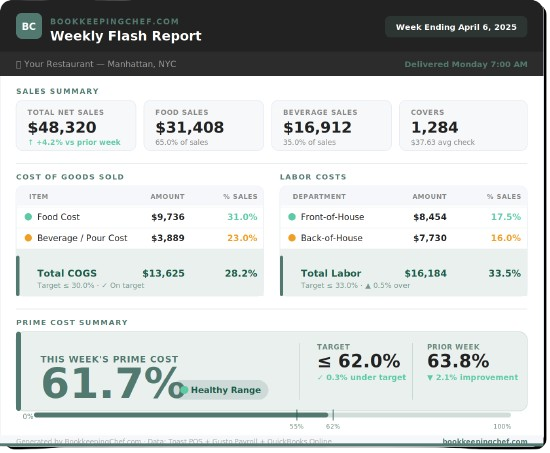
Bookkeeping Chef’s weekly prime-cost reports are provided alongside the financial statements for the month.
Prime cost brings together the cost of goods sold as well as labor, two areas that are able to move quickly in a restaurant. The bookkeeping chef’s provided information states that prime costs usually comprise about 60% of the sales at restaurants.
Consider a situation where sales aren’t changing much however, the cost of prime services are increasing. This percentage isn’t an answer. It provides the person with a reason to investigate.
Did hourly work rise? Did overtime happen? Was the cost of food changed? The invoice of a vendor was unusually high. What changes have occurred in the sales mix?
This is much more helpful than finding the same problem two weeks later.
Let Automation Handle the Repetitive Work
Bookkeeping for your own needs doesn’t have to involve manually transferring POS amounts into spreadsheets after the service.
Modern bookkeeping automation for restaurants can take care of a large portion all the repetitive transfer of financial information. The service is connected to POS systems including QuickBooks, QuickBooks, vendors platforms as well as recipe management and inventory management, and Payment instruments/AP.
The aim is not to automate to achieve its own ends.
The aim is to reduce manually entering data and keep financial records up-to-date so that managers are able to spend more time looking over the data instead of trying to assemble it.
This leads to a different style of bookkeeping in restaurants: technology handles more of the mechanics while the owner remains focused on the financial implications.
Learn to ask the P&L More Questions
A P&L will be much more manageable when you stop thinking of it as an accounting exam.
Begin with sales. Begin with sales. Compare the performance of food and beverages. Look at labor. Move down through operating expenses and then look at what’s left.
Comparing the time spans is crucial.
If profits increased but sales grew, but profit wasn’t, something else between those two lines occurred. Consider what has changed within the organization when food costs grew. Review the staffing numbers and sales activities if labor percentages changed. Investigate if a number seems unusual, rather than believing that the restaurant had poor times.
Bookkeeping Chef offers monthly P&Ls that are finalized in five business days. Business owners can look over the performance of their business without waiting months to receive financial statements.
For owners searching bookkeeping restaurant solutions, speed is useful but understanding is the bigger objective.
You don’t need to be a pro by doing it yourself
There’s a middle way between delegating all financial function to someone else and having your own full-time bookkeeper.
A business owner can be engaged without having to manually complete each accounting job.
This may mean the use of automated systems to keep track of information flow, reviewing the monthly P&L and a weekly report on prime costs and asking questions in the event that something unexpected happens.
Specialized restaurant bookkeeping services could support that approach by keeping the underlying books organized while helping the owner get the meaning of the reports.
It is highly unlikely that you’ll find one who can carry out all of the tasks.
It’s an owner who can have a conversation with a P&L and have an intelligent conversation about the business.
The goal of financial independence isn’t just to write more reports, but to reach financial freedom
Restaurants create a lot data. Another dashboard doesn’t have to be a necessity.
The real value is when an operator is able to look at a weekly prime-cost report and see that something has changed, then access the P&L and understand the best way to look into it.
Bookkeeping Chef’s strategy combines restaurant bookkeeping automation weekly reports and monthly P&Ls. the financial support for specific restaurants to help you achieve this.
Automate repetitive tasks. Review prime cost every week. Study the language used in your P&L.
You do not have to be an accountant.
You must become a restaurant owner who is aware of the financial story behind your own restaurant.